.png)

NVIDIA has made Nemotron 3.5 Lightning available in Amazon SageMaker JumpStart. The launch gives ML teams a managed path to deploy an open model aimed at high-volume agentic workloads without standing up serving infrastructure from scratch.
Nemotron 3.5 Lightning is a 30B-parameter model with 3B active parameters per token, built on a hybrid Mixture-of-Experts design. NVIDIA positions it as a fast open model for “always-on” agents where the workload is dominated by routine execution rather than frontier-level reasoning.
That distinction matters operationally. In production agent systems, a lot of token spend goes to repetitive tasks: classifying events, extracting structured fields, selecting tools, validating outputs, and making short-horizon decisions. Those steps are usually latency-sensitive and high-frequency, but they do not all benefit from the largest model in the stack. Lightning is meant to cover that middle layer so you can route expensive reasoning only when it is actually needed.
NVIDIA claims up to 4x higher throughput and up to 30% faster task completion on high-volume agentic workloads. Treat those numbers as workload-specific, not universal. The real question is whether your traffic shape matches the model’s sweet spot: short interactive loops, many parallel agent steps, and a need to keep GPU cost down while preserving enough quality for tool use.
The immediate value of the AWS integration is not the model card, it is the deployment path. With SageMaker JumpStart, you can deploy Nemotron 3.5 Lightning without hand-building the serving stack, tuning container images, or wiring up the usual infrastructure pieces yourself.
That is useful if your team already knows the model you want but does not want to spend cycles on: - picking an inference container and runtime configuration - provisioning the right instance type - wiring autoscaling and logging - validating endpoint behavior under production-like traffic
For teams running agent backends on AWS, JumpStart is the shortest path to an endpoint you can load test, evaluate, and compare against alternatives. It also fits the normal production motion: launch the model, point a harness at the endpoint, measure latency and task success, and decide whether the model belongs in the routing graph.
The launch note also implies the usual SageMaker advantages around managed deployment, which matters more for always-on systems than for one-off demos. If the agent is continuously invoking the model, shaving operational overhead on the serving side is not cosmetic; it directly affects time to production and ongoing maintenance cost.
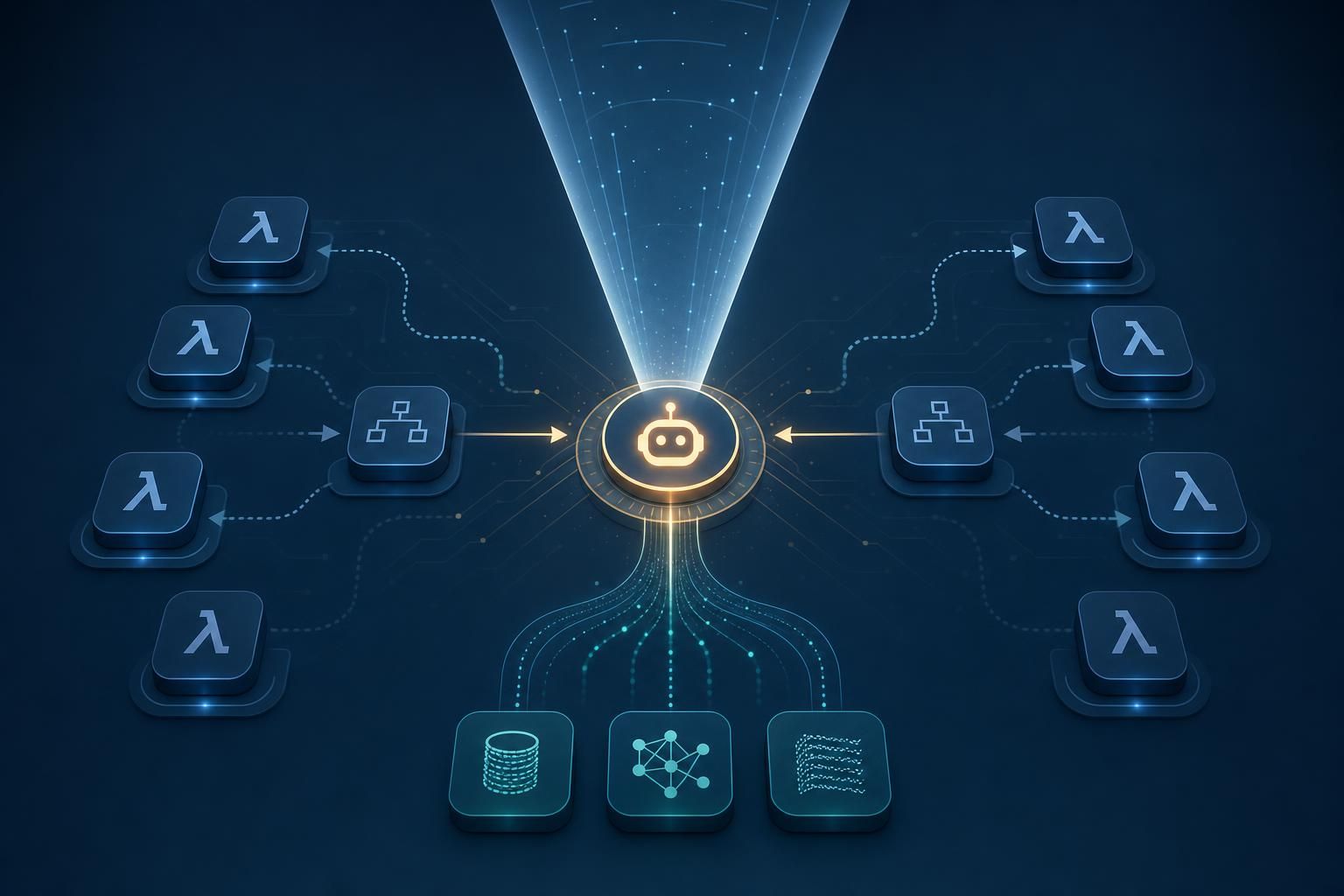
Lightning is best thought of as an execution model, not a universal reasoning engine. It is designed for specialized model calls inside an agent loop, while more capable models can handle planning, decomposition, or cross-step reasoning.
That leads to a practical routing pattern: use a stronger model for high-entropy decisions, then hand off repetitive or deterministic subtasks to Lightning. Examples include tool selection from a constrained set, short-form extraction, response normalization, policy checks, and action execution in long-running workflows. The economic win comes from reducing the amount of frontier-scale compute spent on the long tail of boring steps.
The open-model angle is also important. NVIDIA says Lightning is trained on open datasets and released as an open model, which means teams can customize it, own the resulting weights, and deploy it where their agents run. For production users, that usually translates into more flexibility around fine-tuning, evaluation, and portability than a closed API-only model would allow.
I would benchmark it in three regimes before putting it into a real agent path: single-turn tool use, multi-step short-context orchestration, and bursty high-concurrency traffic. The first tells you whether the model is semantically aligned with your tools; the second shows whether it can survive real agent loops; the third is where the throughput claims either show up or collapse under your actual prompt mix.
For teams already on AWS and already operating agent workloads, this is a straightforward addition to the model catalog: a smaller active-parameter model for the execution layer, delivered through a managed endpoint, with enough openness to make it useful in an MLOps pipeline instead of just a hosted demo.